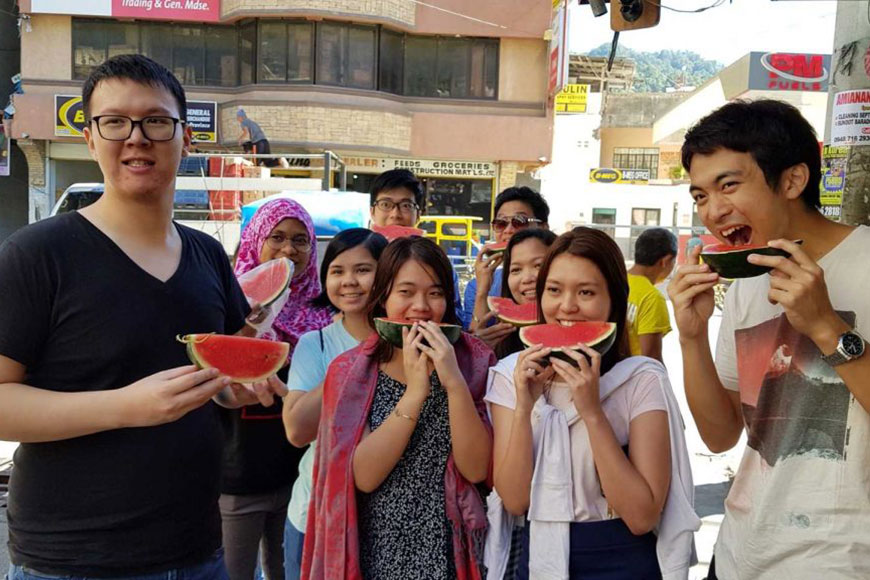
Hiroki Konno (20s), university student (part-time at an accounting firm), internship at Deloitte in Manila (2 months)
Why did you decide to do an internship?
From now on, English will be required not only in accounting but in almost every industry.Many people loudly say that globalization advances daily and business within Japan alone will shrink year by year.
In my fourth year of university I was already working part-time at an audit firm. What surprised me was that the manuals were in English, many working papers were in English, and senior staff almost all had very high English skills. Meanwhile, I had hardly ever studied English in my life, and I was shocked at the gap with those around me.
Since English would definitely be necessary eventually, I thought I might as well work locally where the highest level of English is required, so I decided to join the internship to feel first-hand on site what level of English is needed (lol).
What did you learn from this internship?
I felt that English is just one part of communication, and there are many things you can’t gain from classroom study.
In Japan, there are plenty of ways to study these days, like TOEIC prep and online English lessons. But on site, there’s so much you can’t catch or convey.Moreover, even as an intern it’s real work, and you sign working papers.
There is some responsibility, so I learned that in second-language communication you need the will to ask about things you don’t understand again and again, and to try to convey what you notice and think even if your grammar is a mess. Of course, after two months fully immersed in audit work, I experienced the whole audit process and relationships with clients such as requesting documents, so I learned a lot about auditing as well as English.
Based on your internship, what skills do you feel you need to improve?
I felt my power of expression was overwhelmingly lacking. After two months, there comes a time when you notice you keep using the same words and expressions. I felt the need to read and listen to more varied English and keep studying.
This time you also took one-on-one language study along with the internship. Please tell us the good and bad points.
Before the internship I took one month of language study at Grandline. The curriculum is built to each student’s level, so you can study English at a level that suits you.
The lessons are for learning to speak, so you talk for six hours straight.At first I felt stressed just seeing and hearing English, but you get so much exposure that the stress gradually disappears.

Many of the teachers are young; we went out for drinks many times and joked around. There are lots of fun teachers, so I enjoyed the lessons.
How much money did you need to live in Manila?
Transport was just using Grab taxis, which are very cheap per ride. Food was about 200 JPY for lunch and mostly under 1,000 JPY for dinner.
I also went on two trips with local staff from my internship; one night including food cost under 10,000 JPY. Prices are low, so I rarely had trouble.
Is there anything you’d like to tell future participants, including preparation?
Above all, don’t be intimidated.
Whether or not you can speak English comfortably, this internship program is the best environment. That’s why, once you join, go with confidence and the courage to say you don’t understand when you don’t (lol).
Any comments for those considering joining?
As I said, I really can’t speak English. When I applied, my TOEIC was 450. With that level I was in an all-Filipino environment for two months, but it works out. Most Filipinos are fluent in English, but it’s their second language, so hardly anyone mocks or ignores people who can’t speak it. In fact, they like Japan, so if you try to convey something, everyone listens to the end.
Also, few people at audit firms have interned abroad as auditors, so you’ll be held in high regard after joining.
If you have even a little interest in going abroad in the future, regardless of what you can or can’t do now, take a step out and go see the world! You’ll see differences in working styles from Japan and broaden your perspective.
Daily schedule
| Time | Content | Description |
|---|---|---|
| 7:00 | Wake up | There are many sunny days, so you wake up feeling good. Towels are changed and the room cleaned on weekdays, so the room is always clean and comfortable. |
| 7:30 | Breakfast | Breakfast is at Grandline’s cafeteria. It’s very tasty, with a different menu every day, so I ate it daily for two months without getting bored. They also accommodate requests according to your departure time, so you never miss breakfast. |
| 8:00 | Departure | Leave for the internship. I go to the office by Grab (taxi). The condominium is very close to central Makati, so as soon as you step out, there’s a flow of commuters. |
| 8:45 | Arrival at the internship office | Arrive at the office. It’s in central BGC, in a cluster of buildings like Marunouchi. Security guards are stationed there, which is reassuring for those working in the office. |
| 9:00~12:00 | Office work | For the first two weeks of the internship, I assisted a Japanese expatriate manager in the office. At first, to get used to working in the Philippines, I did simple translations and handled emails. It was the interim audit period, so I constantly went to client sites and audited about four companies. |
| 12:00~13:00 | Lunch time | Sometimes lunch was at the cafeteria in the building, sometimes we went out. The BGC area has a great selection of restaurants. |
| 13:00~18:00 | Office work | Office work in the afternoon too. After two weeks of office duties, I went on site audits, using the same audit tools as in Japan to prepare working papers, request documents and ask clients questions. It was everyone’s first time working with a Japanese person, so they were very interested in me and we worked together in a friendly atmosphere. |
| 18:00 | Leaving the internship office | I basically left at 18:00 as contracted, but during rush hour it was hard to get a Grab, so sometimes I worked until 18:30. |
| 19:30~21:00 | Dinner | I ate out with my Japanese boss, Filipino colleagues and others using Grandline for internships or language study at the same time. There are many restaurants around the condominium, and all are lively at night. |
| 22:00 | Return home | Even when it got late, the admin staff responded flexibly. Walking at night, most streets are well lit, and I never felt in danger. |
| 24:30 | Bedtime | On nights with no plans, I went to bed around 23:00 |
If you’re interested in an overseas internship, please see the details.