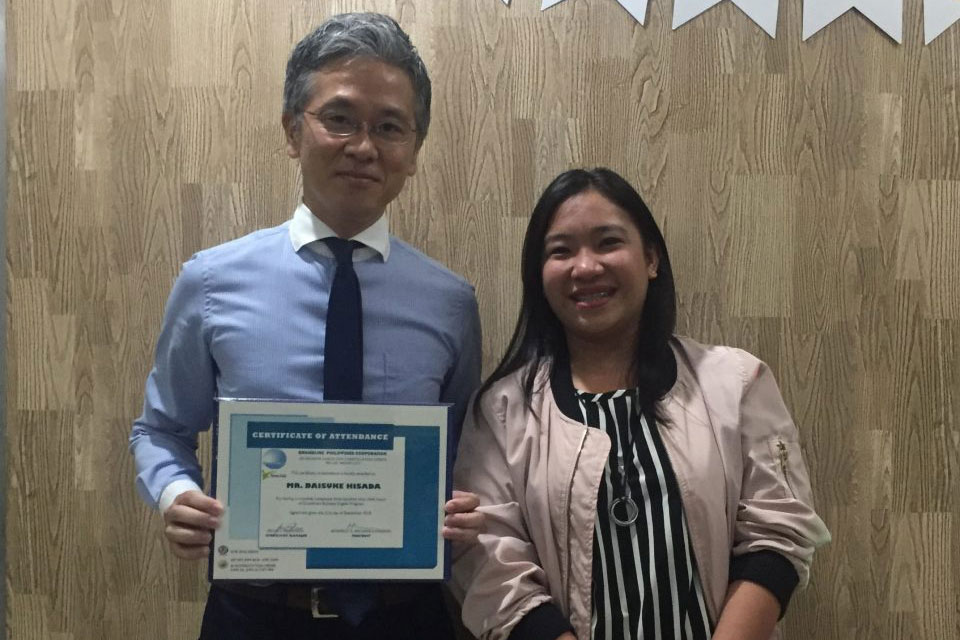
Daisuke Hisada (46), working professional (CRO / pharmaceutical industry), study in the Philippines 3 months
What made you decide to study in the Philippines?
My company has an English training program, and my boss asked me, “Would you like to go to the Philippines to learn English?”
I didn’t hesitate at all and immediately said yes. It was an honor to be given such an opportunity, and since I felt the need for English at work every day, it was exactly what I wanted.
Please tell us about your usual work and, if you use English, in what situations.
I coordinate the hosting of client audits and handle them on the day. As a service provider, we host dozens of audits a year as a contractor (roughly one every two weeks).
As is clear from our sales, the majority of our clients are foreign companies, and more and more audits are conducted in English by auditors from their home countries. Most of these global (international) companies stay for several days per audit. Preparation (scheduling, answering advance questions), attending on the day and improvement activities after findings are all done in English.
So situations requiring English in my work are increasing daily (emails, face-to-face conversations). Our company is also internationalizing with Asia as a base: the master versions of procedures are written in English, and internally English is increasingly the “official” version of documents. We are also strengthening collaboration with Asian subsidiaries, so English use within the company will keep increasing.
Given this situation, my boss considered sending me to the Philippines, and I also felt I needed to learn English.
Have the lessons been useful in your current or future work?
I was able to raise my weak English to a higher level, which helps in every work situation.
In particular, I’m responsible for hosting auditors visiting from abroad and accompanying them throughout the audit, so from advance coordination (emails) to “conversation” during the audit, it’s useful at every step. In the future I expect to use it even more, including collaboration with our overseas group companies.
How was the difficulty of the lesson curriculum?
I wasn’t sure how to put it, but my answer is: a level that feels a little difficult = just right.
To improve your English, you need to be stretched and under some load. I feel my MIC (main coach) controlled that very well.
They pointed out my weaknesses and combined programs and exercises accordingly.I think they maintained an exquisite level of difficulty, always a little above what I could do, but not so hard that I’d get discouraged.
The modules used in regular lessons — topics that are hard to discuss even in Japanese, such as those below — helped strengthen my English as well as my growth and thinking as a business person.
Work Life Balance, Personal Branding, Cross Cultural Sensitivity, Globalization and Innovation, Diplomatic Language for the Workplace, Employee Engagement, How to Make a Good Impression in a Conference, Corporate Social Responsibility, Tipping Point Leadership, Corporate Governance.
How were the Filipino teachers?
They taught very attentively and ran the lessons with good communication, including humor.
Including technical points such as pronunciation and grammar, they gave well-timed corrections and guidance, understood what I wanted to say and suggested better expressions — full of insights for improvement.
If I had to name room for improvement: when a lesson went too fast, some teachers flexibly prepared other training on the spot, but I felt there could be more flexibility in adjusting the teaching approach based on my reactions and ability.
How was the Speech Workshop?
It was very meaningful as a “practical arena” different from one-on-one lessons.


It’s tough from preparation to the day itself. You choose a topic on the theme, think through the story, and on the day you have to speak one-to-many, including impromptu speeches. I felt how hard it is to do in English what would be easy in my native language, but that led to an objective evaluation. By analyzing what went well and what failed, I could grasp my own abilities.
What did you learn from studying in the Philippines?
I learned more than English.
I felt first-hand how to communicate with people from various backgrounds (teachers, local staff and the many people I met in the city).
Understand and respect others, and when necessary assert yourself while showing respect. I feel I couldn’t have learned this just staying in Japan, working in a homogeneous society with shared understanding.
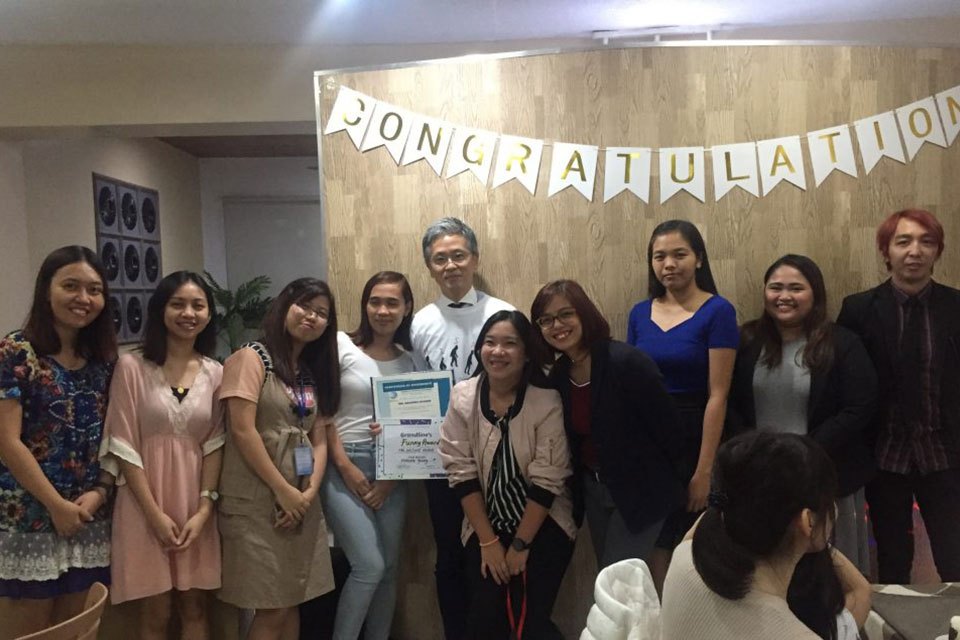
Of course, it was also very effective for my main goal, English. By the end I could communicate with the teachers without any real difficulty, so I think I clearly changed from before. (There were parts I couldn’t fully master by the end, but knowing what to keep working on is also a result.)
What are your plans for learning English going forward?
At my level, I feel I’ve built a foundation for learning English. With a strong foundation, building on top becomes easier. The challenge is how to keep learning and improve all skills (reading, writing, speaking).
During my stay I needed English even in daily life (shopping, laundry, etc.), so I used it naturally, but I realize that after returning I have to actively create opportunities. Fortunately, there seem to be a fair number of chances at work, but I want to deliberately create an environment where I use English.
Is there anything you learned in the Philippines that you’d like to tell future students?
Manila/Makati has everything. I expected that to some extent, but it exceeded my expectations. I wondered if I’d miss Japanese food, but even when I did, I could get plenty of Japanese food, from instant food to restaurants. You might think about bringing some retort or instant Japanese food, but if you want to pack light, it’s completely unnecessary — you can get it in Manila.
Safety was also different from what I expected, in a good way. Of course you always need to be careful, which isn’t the case in Japan, but with minimum precautions you’ll be fine. I never ran into danger and had a very comfortable stay.
If you want to master business English efficiently, please see the details of studying in the Philippines.