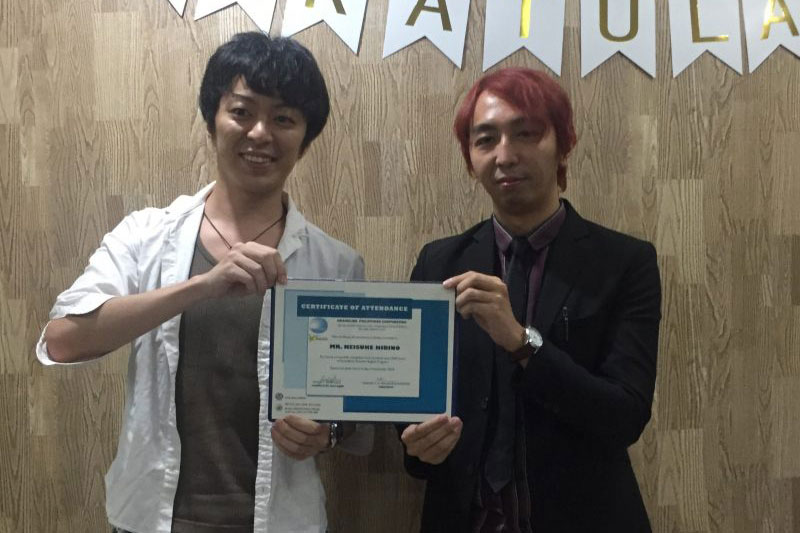
Keisuke Hibino (20s), study abroad (3 months), CRO industry (Contract Research Organization). English level 3 (Low Intermediate) → level 4 (High Intermediate)
What made you decide to study in the Philippines?
My company was recruiting for a language study program, and I applied because I saw it as a chance to improve my English. I studied for 3 months through my company in July 2018, then for one week privately in May 2019 to brush up.
Please tell us about your usual work and, if you use English, in what situations.
I conduct drug development on behalf of pharmaceutical companies (clients). Currently I visit hospitals in Japan to explain clinical trials to doctors and have them conduct them, so English isn’t a large part of my work. However, I believe English will become more important as I move up, as the company globalizes and as the share of overseas clients grows.
Have the lessons been useful in your current or future work?
To improve your English, your teacher sets an individual, business-oriented curriculum. In my case, I practiced every day discussing various business topics such as globalization and diversity with highly skilled Filipino teachers with different values.
In the first half, I thought I was struggling with English, but even more I felt the difficulty of conveying my own opinions. How to express in English my values and nearly 30 years of living as a Japanese person — and I often lacked even basic knowledge about my own company, Japan’s environment and history. Beyond language, every lesson made me think hard.

Please tell us your impressions of the Speech Workshop.
Through the Speech Workshop, I shook off the common Japanese assumption that “I can’t speak English unless I prepare”.
Repeatedly being put in situations where I had to output English as a presenter, I feel my ability definitely improved.
In the Real Meeting, I also had the chance to discuss with someone from a pharmaceutical company in Manila without the teacher’s support. I thought I had prepared several questions, but they were used up in a few minutes, and honestly I panicked about how to keep the conversation going.
But I hung in there despite making mistakes, and the one-hour session was over in a flash. English ability matters, of course, but as non-native speakers we often make mistakes or get stuck; I learned first-hand that the attitude of keeping the conversation going is even more important for building relationships in business.
What goals, challenges and plans have you identified through studying in the Philippines?
In the near future, I want to lead the company as a global leader.
If I just quietly get my work done, I might reach a certain position and deal with overseas clients as a leader. But beyond that, I think I need to lead efforts to promote collaboration with overseas branches and group companies to improve company synergy.
Different values and the Japanese tendency to be unable to fully convey our value will be barriers. I want to be the person who breaks through them.
How was studying in the Philippines twice?
Improving English feels like an endless journey. At first I thought that after 3 months I’d be able to watch movies and dramas smoothly, but I was wrong (lol). After returning, steady practice is essential.
The second time, I joined privately for a week to boost my motivation. I was very happy to have conversations in English with my teachers that were many times deeper than before. But I also found many challenges, like “I still don’t know the vocabulary or expressions for this kind of topic”. There’s still a long way to go, but I’ll keep working hard.
Please share your impressions of the Philippines
A cheerful, bright culture, and a truly deep country where many nations mix.
Compared with other Philippine cities, Manila is a bigger city than I imagined with active business, but just outside the center there are still slums and you feel the atmosphere of a growing country. Still, it’s not very dangerous, prices are low and there are restaurants of every kind including Japanese, so I had no trouble with food.
People sometimes ask, but unlike Cebu, Manila basically doesn’t have marine sports (lol). But as a place for English training — 4 hours from Haneda, with active business and low prices — all things considered, Manila is a wonderful place.
If you want to master business English efficiently, please see the details of studying in the Philippines.