
Akiyo Nogawa (30s), homemaker, day classes (6 months), English level 1 (Low Beginner) → level 2 (High Beginner)
What made you decide to study English at a school in Manila?
I came along when my husband was posted to Manila, and I was looking for a school I could attend because I wanted to improve at least my English while I had the chance. In Japan I rarely used English. I thought I was reasonably good based on my school days, but once I started living in Manila, I was surprised that only the bare minimum words came out, and by how much better Filipinos’ English was than I imagined.

When I asked myself who is more competitive globally — a Japanese person who can’t speak English or a Filipino who can — I thought, “maybe the Filipino who can speak English”. I realized again the importance of being able to communicate in English, and thought that if I could speak more freely, I might expand my possibilities and see a different world.
I’m very curious, so imagining what world might open up made me really excited. There’s a high chance I’ll keep living abroad for a while, and I thought, if not now, when will I study English again? So I decided this was the perfect chance and started attending classes.
What time and how often did you take lessons?
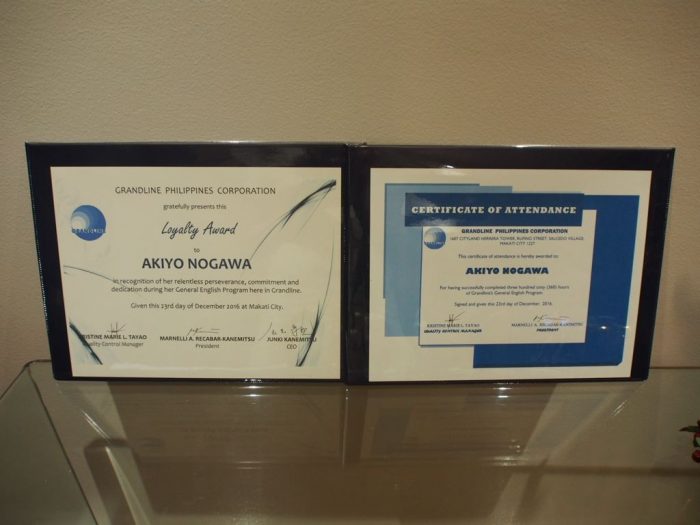
I commute from within Makati and signed up for the 360-hour course. I attended 3 hours every day Monday to Friday, either 9:30–12:30 or 14:00–17:00, for about 6 months.
The lessons were mainly free talk. There were materials, but we exchanged opinions and shared information with the teacher on topics prepared in them, and sometimes talked about things happening around us unrelated to the materials.
Sometimes we chatted casually about food or hobbies, and sometimes we had serious talks about politics or economics. There was a 10–15 minute break during the 3 hours. Lessons were basically every day, but when something came up, they changed the schedule if I asked in advance, so I could keep going without strain.
What goals, challenges and plans have you identified through the lessons?
Before taking Grandline’s lessons, I had taken a placement test (conversation) at another school I was considering. When I took it again after finishing Grandline’s 360-hour course, my level had gone up three steps. My grammar and vocabulary still need work, but setting that aside, I definitely felt my conversational ability improved.
I feel that “conversing continuously” every day is the fastest way to build conversation skills. Training vocabulary and phrases by actually using your ears and mouth — the longer you do it, the more surely English sticks. Now that lessons have ended, I feel restless that if I don’t touch English, my 360 hours might go to waste (lol).
My ears have adjusted to some extent and I’m no longer reluctant to speak English, so I want to keep working to expand my vocabulary and express more things fluently. As your English comprehension rises, your information and network grow two or three times.
My future is still vague, but I feel I can do anything, which excites me, and I’ve developed a desire to speak even better. I want to challenge myself to see how far I can improve.
I used to be a pastry chef, and I’d like to promote Japanese sweets abroad someday, so during my stay I gathered about 10 Filipinos interested in Japanese sweets and held a cake-making class.
If you’re looking for a school in Manila to learn English, please consider Grandline.